
Above Ground
on arrival, journey, and the space between

It was last Wednesday, and I was walking south from the British Museum, meandering left and right through streets, led not by a map but by whatever building, sign, or public space caught my fancy. I turned a corner and found myself at the entrance to Dishoom, where I had eaten a delicious Indian meal on my last visit to London. Great memories flooded back, quickly followed by confusion.
Wait, really? Dishoom is in Covent Garden. I was just at the British Museum. They aren’t close. What’s going on?
I pulled out my phone. The map confirmed it. Covent Garden and Bloomsbury—the site of the Museum and the location of my apartment for the week—were right there, adjacent to each other on the screen.
I had walked about half a mile and entered a completely different world.
As I continued walking and pondering this new understanding of the city, my Fitbit began vibrating on my wrist: 20,000 steps and counting. And it was only 3 p.m. I had started the day with a pre-dawn stroll from Bloomsbury to Cleopatra’s Needle and along the Thames to take in the sunrise, visited the Turner & Constable exhibit at the Tate, and had been walking ever since.
It was day ten of my two weeks in London, and I was seeing things in an entirely new light.
When I arrived in London, Hampstead in the northwest of the city was my soft landing. Leafy, village-like, reminiscent of Brookline, it was exactly what I needed for my first week—a planned time of retreat to reset and ground myself before moving on and picking up the Blue Car.
I loved the neighborhood cafes, my daily walks through the Heath, and all the pubs and shops. My apartment was a block from the Underground station, and I made good use of my 7-day unlimited London Transport Card to head into the center for theater, music, and art. I hopped in and out of Tube stations all over London—from Golders Green to Putney to the Docklands—moving efficiently from point to point.
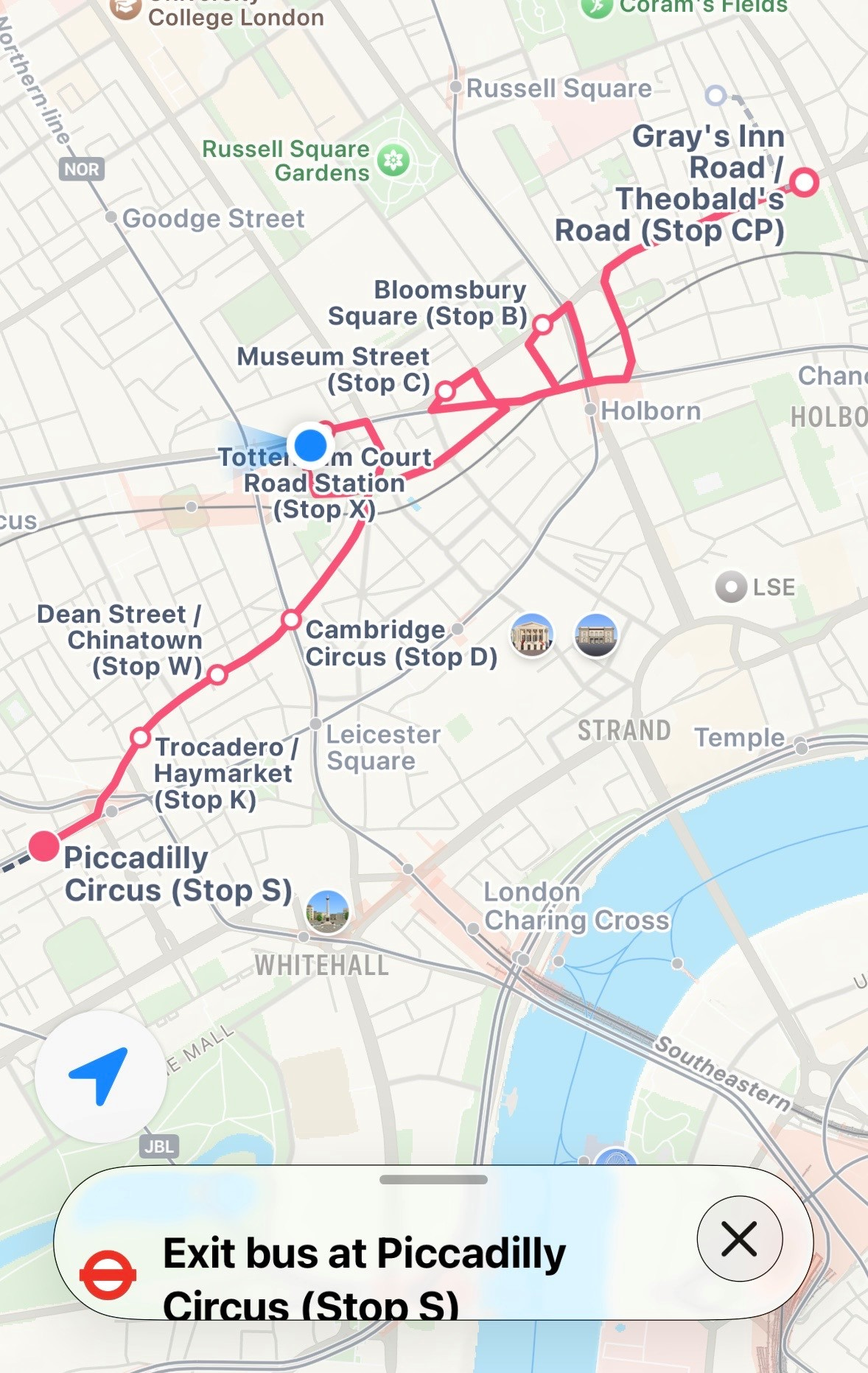
At the start of my second week, I moved to the edge of Bloomsbury and into the thick of things. But my apartment was just far enough from the nearest Underground station to make walking and buses easier. I didn’t take a single Tube ride that second week. Instead, I traveled above ground, shifting my focus from Tube station nodes to the pathways that connect neighborhood to neighborhood in a web of sidewalks and bus lines.
I certainly walked during my first week. But the Tube was my connector to destinations beyond Hampstead. In Bloomsbury, walking and buses became my connectors. My 20,000 steps before dinner last Wednesday became the new norm (so much the better to work off the pint of ale at the pub).
In choosing two very different places to live, I very deliberately chose to experience two different parts of the city. What I hadn’t anticipated was that I would not only see different sights, but that I would come to understand the whole city in a deeper way.
The London Underground is efficient, clean, and miraculous in its way. But underground, you lose the in-between. You surrender the paths. You surface into isolated universes. Standing in front of Dishoom and realizing how close it was to Bloomsbury, I understood that I had spent the week in Hampstead moving from node to node with my eyes closed.
Not literally closed. But sitting comfortably on a train moving quickly through tunnels (113 of the system’s 250 miles of track are below ground), I had no clear sense of the places between my destinations. I studied maps. But the city remained abstract. Each time I climbed the stairs to emerge from the depths of the Tube, I greeted a single node, largely unaware of the wider urban ecosystem connecting it to everything else.
There’s nothing inherently wrong with how I traveled that first week. This is not a diss of the London Underground. But the contrast between week one and week two is the contrast between seeing where you are going and experiencing only the arrival.
This past week filled with hours of walking and riding atop red double-decker buses has given me a fuller sense of London, one with the beginnings of connections that are historical, physical, and social.
At the end of my first week, had I drawn a map of London, it would have consisted of Tube stations floating in a void. In my training as a city planner, Kevin Lynch’s The Image of the City became a touchstone. He argued that cities are legible through five elements: paths, edges, districts, nodes, and landmarks. My first week in London, I knew only the nodes.
Yesterday, sitting in the lobby of the National Theatre—another generous “third space”—I gave myself an assignment: draw London from memory.
The resulting map tells the story of where I have been. Daily walks. Rides on the #243 and #55 buses. Repeated crossings of familiar landmarks. The Thames as a major element, a constant reference point as I moved throughout the city above ground. The beginnings of a web. A greater London. A whole built on shared history and overlapping lives.
An understanding that feels real. Earned. Lived in, even if only briefly.
And so I wonder how I travel through my world at home.
What if I drew a map of my life in the U.S.? It would be many maps—two homes, multiple circles of friends, family spread across distances. But most importantly, those maps would include the web of people, places, and systems that make daily life possible.
The grocery clerk who has stood at the same checkout for years. The bookstore employee who helped me order Michelin maps for this road trip and knows I am intentionally foregoing GPS in celebration of getting lost. The friend who calls each morning to check in. The shared dog-walking routes we rely on when our schedules align.
The shipping agent who emailed updates from Port Newark/New York. The representative in Le Havre who writes “Bonjour Suzanne” with news of the Blue Car’s whereabouts. The town planner recruiting the cafes and shops that make home feel vibrant.
This is the map of the social, emotional, and physical networks that make things run smoothly—and hold when they don’t.
My London map has gaps. Some streets are misplaced. Some distances skewed. No matter. I now see the edges and the paths. I know what I don’t know.
Moving through life with my head down in the tunnel can create the illusion of independence. Of isolation. The above-ground view tells a different story. One of interdependence. Of connection. Of systems larger than any one destination.
The contrast between traveling below ground and in the light of day is the contrast between efficiency and immersion. Between knowing only the nodes and understanding the paths. Between speed and legibility. Abstraction and embodied knowing. Between arrival and journey.
It seems inevitable I would land here—arrival and journey. I am sitting at Heathrow now, boarding pass in hand, waiting to fly to Paris and begin the road trip in a rental car while the Blue Car continues its own voyage across open water. Its arrival port has shifted again. Not to Le Havre today as expected, but to Antwerpen first tomorrow. Nodes rearranging themselves.
For weeks I have tracked those nodes obsessively. But the real story is not the dots on the map. It is the line between them—the stretch of sea, the streets between the Tube stations, the steady forward motion.
If London has taught me anything these past two weeks, it is this: the in-between is where understanding grows. The path is what makes the nodes meaningful. And the journey, above ground and in the light, is where life actually happens.
Susan
From the Blue Car Europe Series
For the First Essay in the Series: A Glimmer of an Idea
For the Previous Essay: Third Places
For the Next Essay: Road Notes: Omaha Beach
A timely reminder, living in this fast paced world, it is the journey, not the destination, that fills our lives, if we take notice. Thanks, again, Susan. Another tip for living FULLY!
Nancy Clayman
This reminded me of our trip to Paris with the boys so many years ago- we had an apartment in Montmartre with a wonderful terrace and Sacre Coeur as out nightlight. For most of the week we were there we used the Metro and thus experienced Paris as a city of nodes much like your first week in London; on almost our last day I said let’s ride the buses today and we spent the day going all over central Paris on buses- and what a difference in how we saw the city; knitted together into a whole skein rather than knots on a string. Lovely essay- glad you are getting back together with the blue car soon. Want to hear from the blue car- how was their journey? Exciting? Lonely? Scary?