
84 Days: The Cheat Sheet
reflections from somewhere in the middle of a road trip

Tomorrow morning, I will drive a few miles from my hotel here in Folkestone and take the Eurotunnel to France: the Blue Car in a vehicle carriage, me inside with the engine off, on a 35-minute train ride beneath the English Channel, back to the European continent and northward bound on the third and last leg of this European road trip.
I have been traveling for twelve weeks now.
My journal, so fresh and empty on February 15, no longer has room for new adventures. The final four pages hold a wobbly pencil-drawn grid for each day’s odometer reading and evening destination, along with the Blue Car’s fuel consumption in liters, the price per liter (ouch), and the total paid at the pump. In the back is a small pocket where I have stored the 21 receipts from my gas fill-ups.
Inspired by an art exhibit I saw a few weeks ago, I have a vague idea of creating some kind of collage artwork with the gas receipts and trip photos this winter, when the Blue Car is covered and asleep and I am looking back on this journey as if it were a dream.
But for now, my thoughts are elsewhere.
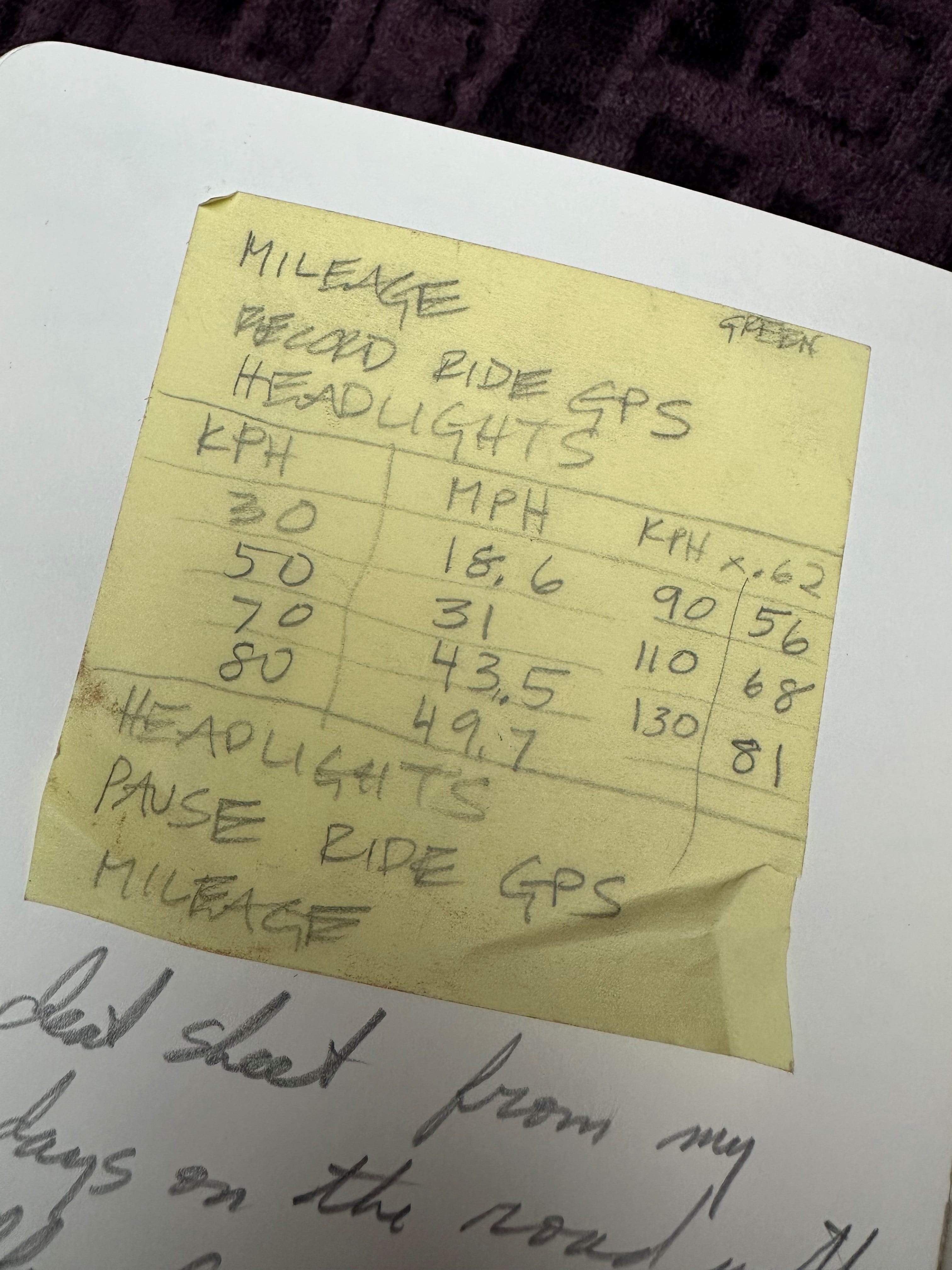
This morning, as I pulled the receipts from the back pocket of the journal, a small Post-it note fell to the floor. It was torn at the edges and crumpled a bit. I picked it up and smiled.
It was my cheat sheet.
It is now pasted into the back of my journal: a memory, a fragment of who I was and what I thought I needed at the start of this trip.
For the first three or four weeks on the road, I kept this little yellow slip of paper taped beside the ignition switch. I was searching for a routine then, worried about forgetting something important. The list reminded me to record the previous evening’s odometer mileage, hit the “start ride” button on my Ride with GPS app, and turn on the headlights.
In the middle of the note are my KPH-to-MPH conversions, because Porsche, apparently, did not imagine this car would be enjoying European roads more than five decades later.
And then, of course, everything in reverse at the end of the day. Stop the app. Record the mileage. Turn off the headlights.
Especially turn off the headlights.
Everything was so new in those early days. Every morning had a little tremor of uncertainty, and every evening had a checklist. I was still trying to get my footing, not just with the car, but with the rhythm of this journey.
I think it took me until the Romantische Straße in Germany to tuck the Post-it into the ashtray, where it kept my lipstick company. Then, sometime around the Nürburgring, I must have moved it into the back pocket of the journal.
And then I forgot about it entirely.
It all seems so quaint now. A little bit silly, even. My worries about routine, speeding tickets, fuel stops, headlights, and draining the battery overnight. Did I really write that list so carefully in pencil the first night I finally had the Blue Car in Le Havre?
So very long ago. Another life.
I am now in the phase of the journey where it feels as though it could go on forever. The days flow one into another in a rhythm that has become natural and sustaining. I know where every item is in the car, each tucked into the place where it is most useful and accessible. I have settled into my passenger seat as if it is the home it truly is. I read the roads without thinking too much and have adapted to the left side of the pavement after four weeks in the UK as if I have been doing it forever. Most of all, I am comfortable with the unknowns: the streets that get narrower and then end in a field or someone’s driveway, the improvised shifts in plans.
And now, as I sit with my glass of wine, fresh from a conversation with the couple at the next table in my hotel bar who have a brand new Porsche and are embarking on a six-week road trip to France (serendipity strikes again!), I am acutely aware that these twelve weeks have passed in the blink of an eye.
And that only six remain.
As I look toward the Channel crossing tomorrow morning, I feel nostalgic and reflective.
Blame it on the Post-it note.
Is it too early for road trip reflection? I have been asking myself that all day. But perhaps the middle, or the beginning of the end, is exactly the right time to take stock.
On my U.S. road trip, I remember driving the Pacific Coast from Oregon to Los Angeles and then turning eastward for the first time. I knew then that I was on the return leg, and something shifted. The trip was not over, not even close, but it had changed in some fundamental way.
This moment feels similar.
Tomorrow, I leave Britain and return to the Continent. Ahead of me is Scandinavia, and with it a strange sense of coming home. Not because I am from Scandinavia, but because it was there that my world first opened.
When I was in architecture school, I spent a summer studying in Denmark. It was there, at the age of 20, that I began to understand there was more than one way to live a life. More than one way to organize a city, raise a family, move through a day, think about beauty, share public space, and imagine what might be possible. I had been raised in an insular community on Staten Island, and suddenly the world felt larger than anything I had known.
That summer did not change everything all at once, because life rarely works that way. But it did crack something open inside me. A good kind of crack. A crack that let the light in. A crack that let me glimpse who I wanted to become.
And now I am marveling at how much room there can be for many transformative moments in our lives, if we decide they do not have to stop when we are adults, when we have responsibilities, when we retire, or when we think we should already know who we are.
The cheat sheet is a reminder of the person who began this journey twelve weeks ago: hopeful, a little nervous, determined, and trying very hard not to forget the headlights. She needed a list taped beside the ignition. She needed kilometer-to-mileage conversions written in pencil. She needed a routine because the road ahead was unfamiliar.
And when things are unfamiliar, I always look for an anchor to keep me grounded while still moving me forward.
That Post-it note did the trick then.
And I do not need it now.
Instead, I carry new internal knowledge, the kind that sometimes takes reflection to reveal.
I have learned that I still love traveling solo, but that it may be time to think about a different kind of trip. I can be an impatient person, and deep loss has given me a sense that we should not hesitate to live. That we need to seize moments now, not later. Not someday. So, I am traveling solo because that is better than not traveling. But I also want more than solitude.
In moments of Blue Car breakdowns, sunsets on beaches, spectacular dinners, special wines, ordinary mornings, and small triumphs, I have felt the absence of a partner. Someone to share the highs and lows. Someone to steady me when I waver. Someone to laugh with when the whole day goes sideways. Someone who would understand why a tiny yellow cheat sheet falling from a journal could make me suddenly emotional in a hotel room in Folkestone.
I do not know what I do with that realization yet.
Maybe it is enough, for now, simply to write it. To say it.
I have also been reminded how much I love the practical brilliance of the world. As a city planner and as a lecturer at MIT, I was fortunate to travel to many places to talk, learn, observe, and share ideas. I have always loved discovering a better way to do something.
On this trip, those small discoveries have delighted me again and again.
In French towns, the traffic lights are not strung overhead on ugly wires or hanging from large clunky poles, cluttering the visual landscape. They sit on small posts at the corners, and halfway down those posts is a smaller set of lights, directly in front of the driver waiting at the intersection. No craning of the neck, no mishmash of wires, no need to install large poles at every corner. Simple. Elegant. Useful.
In London, double-decker buses have phone charging ports at every seat.
In Holland, my hotel offered a voucher for a free drink in lieu of having my towels and sheets replaced every day. The receptionist told me 95 percent of guests choose the voucher, and everyone wins, including the environment.
Everywhere, there are little lessons in how to solve the ordinary challenges of daily life. No place has a monopoly on the best ideas. But every place has something to teach, if we are willing to look.
I have also been thinking about the younger version of myself who first fell in love with the wider world.
In January, I bought a new iPad to replace my 13-year-old model. Its name is “Suzzy,” which is my nickname — used by only a few people in my life, mostly from my late teens and early twenties. With location services turned on, a message sometimes pops up on my phone as I walk away from the Blue Car or leave my hotel room and the IPad:
“You have left Suzzy behind.”
It makes me laugh every time.
And then it makes me wonder.
I have indeed left Suzzy behind, but hopefully not all of her. I am not the young woman who first stepped off a plane in Copenhagen and felt her life expand. I am not the young wife and mother grieving the death of her husband, the overwhelmed professional starting a new business from the desk in the corner of her bedroom, or even the woman who set off across the United States in the Blue Car less than three years ago.
And yet all of those selves are still with me. They are tucked into the back pocket of the journal too, crumpled and worn at the edges, waiting to fall out when I least expect them.
Maybe this is what I love most about travel. And yes, about getting older, if we do not fight it too much and let it work its magic. Travel does not erase who we were. It lets us meet those earlier selves again from a different vantage point.
Most of all, I have learned to lean more fully into the unplanned and the serendipitous.
This may sound ridiculous given how much I planned this road trip. For more than a year, I thought about the Blue Car’s shipping, the route, the timing, the documents, the ferry crossings, the insurance, and the broad shape of the journey.
But the planning was mostly scaffolding. The real trip has happened in the spaces between.
The vineyard tour and lunch that came because the Blue Car was in the shop for repairs. The unexpected meetings and conversations. The friend of a friend who appeared at my door. The castle seen from the wrong angle, which turned out to be the right one.
Last year, I wrote a lofty essay about wanting to do this trip without GPS.
That noble experiment lasted approximately one hour.
Without a navigator in the passenger seat, this trip would have become a miserable series of stops, starts, and muttered curses. So, I found a compromise. I plot a route on my Michelin map, input stops into my GPS app, and then ignore it just enough to follow roads that look interesting. I let the app help me, but I do not let it own the day. And I am not embarrassed to say my lofty plan did not hold up to the realities of the trip.
That may be the best metaphor I have for these twelve weeks.
Have a plan. Tape up a cheat sheet if you need one. Write down the conversions. Remind yourself to turn off the headlights.
Then, when you are ready, tuck the list away. Make no apologies. Trust your instincts.
There is no shame in needing help at the beginning. There is also great pleasure in realizing, somewhere along the way, that you have internalized the rhythm.
This afternoon, I opened a new journal and wrote on the first page:
European Blue Car Road Trip Book #2.
The blank pages are waiting for Scandinavia.
More roads to enjoy. More places to visit. More ferries, bridges, small towns, museums, coastlines, meals, mistakes, and moments I cannot possibly predict from here.
Tomorrow morning, I will get in the Blue Car and check the mileage. I will start the app. I will turn the key and turn on the headlights.
I will drive onto the train in Folkestone and emerge in France.
And then I will simply go.
Susan
Blue Car Road Trip Miles: 4,759
From the Blue Car Europe Series
For the Previous Essay: What’s in a Name
That was so beautifully written, Susan. How perfectly you described your parallel journeys in car, in mindset, and in life.
Coincidentally, I’m sitting here at my breakfast table in Co. Kerry, Ireland with a blank Leuchtturm notebook that’s waiting to be filled with mileage logs. Rather than a simple numeric record of fuel economy, I’m borrowing an idea from another Porsche owner and recording the locations of the fill-ups. Where will we go in Bluey? What memories will this list recall when I look back at them as future me? I can’t wait to find out. But first, to drive serendipitously like you.
A new notebook for the next chapter! Have fun